Presentation at GEBF Conference 2026: EDUGENIA Toolkit on Critical AI Education
Download Pdf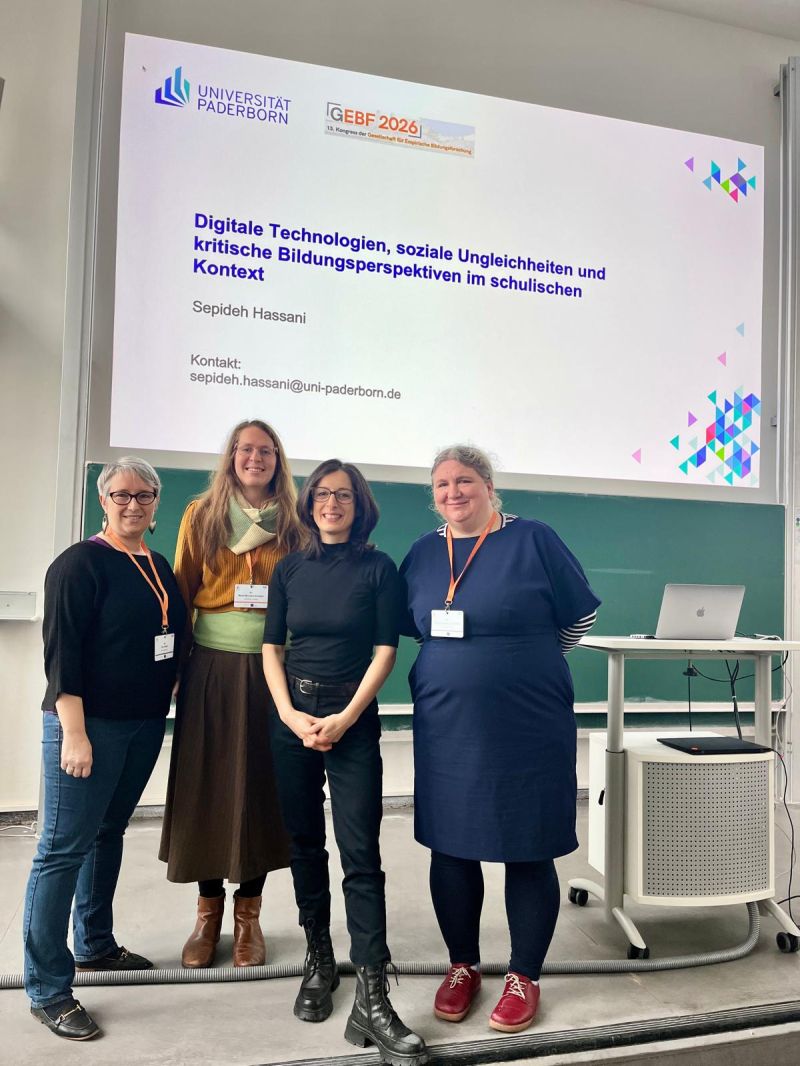
We are pleased to share that Marie-Monique Schaper, member of the GRIHO research group participated in the GEBF Conference 2026, held at the Technical University of Munich (TUM).
During the congress, she presented the educational toolkit EDUGENIA as part of the symposium “Digitale Technologien, soziale Ungleichheiten und kritische Bildungsperspektiven im schulischen Kontext” (Digital technologies, social inequalities and critical perspectives on education in school contexts), chaired by Sepideh Hassani (University of Paderborn).
About the EDUGENIA Project
The EDUGENIA project addresses artificial intelligence not only as a technological innovation but as a broader social and ethical challenge. Algorithmic systems often reproduce and reinforce existing inequalities, disproportionately affecting women and marginalized groups. However, current school curricula tend to emphasize technical competencies, leaving limited space for critical reflection.
To respond to this gap, EDUGENIA provides a toolkit designed to support secondary school teachers in integrating AI education from an intersectional and gender-sensitive perspective.
This work has been developed through a collaboration between the GRIHO research group (members Marie-Monique Schaper, Rosa María Gil, Mercè Teixidó) at the University of Lleida and the GenTIC research group lead by Milagros Sáinz at the Open University of Catalonia, forming an interdisciplinary team bridging computer science and social sciences. EDUGENIA emerged from #ACTFEM®, a project initiated and led by Plàudite Teatre. Building on this initiative, the research was carried out in collaboration with the Universitat Oberta de Catalunya and the Universitat de Lleida, with funding from the Spanish Institute of Women.
Methodology
The project combines several complementary approaches:
- A literature review on AI education and digital empowerment
- Policy analysis at European, Spanish, and Catalan levels
- A participatory study involving secondary school teachers
Key Contribution
EDUGENIA represents a pioneering resource in Spain, aimed at fostering critical thinking, inclusion, and digital empowerment in secondary education.
Symposium Contributions
The symposium also featured notable contributions, including:
- “Mein sicherer Raum? Zugehörigkeitsgefühl von Schülerinnen in der datafizierten Schule” by Elisabeth Anna Guenther (University of Vienna)
- “Von flüchtigem Blick zu kritischem Wahrnehmen” by Elke Höfler (University of Graz)
Acknowledgements
We would like to express our sincere thanks to Sepideh Hassani for organizing and leading this inspiring symposium. We also extend our gratitude to all co-authors, collaborators, and the conference organizers for fostering such a valuable space for exchange and dialogue.
We look forward to continuing the discussion on critical and inclusive approaches to AI education.